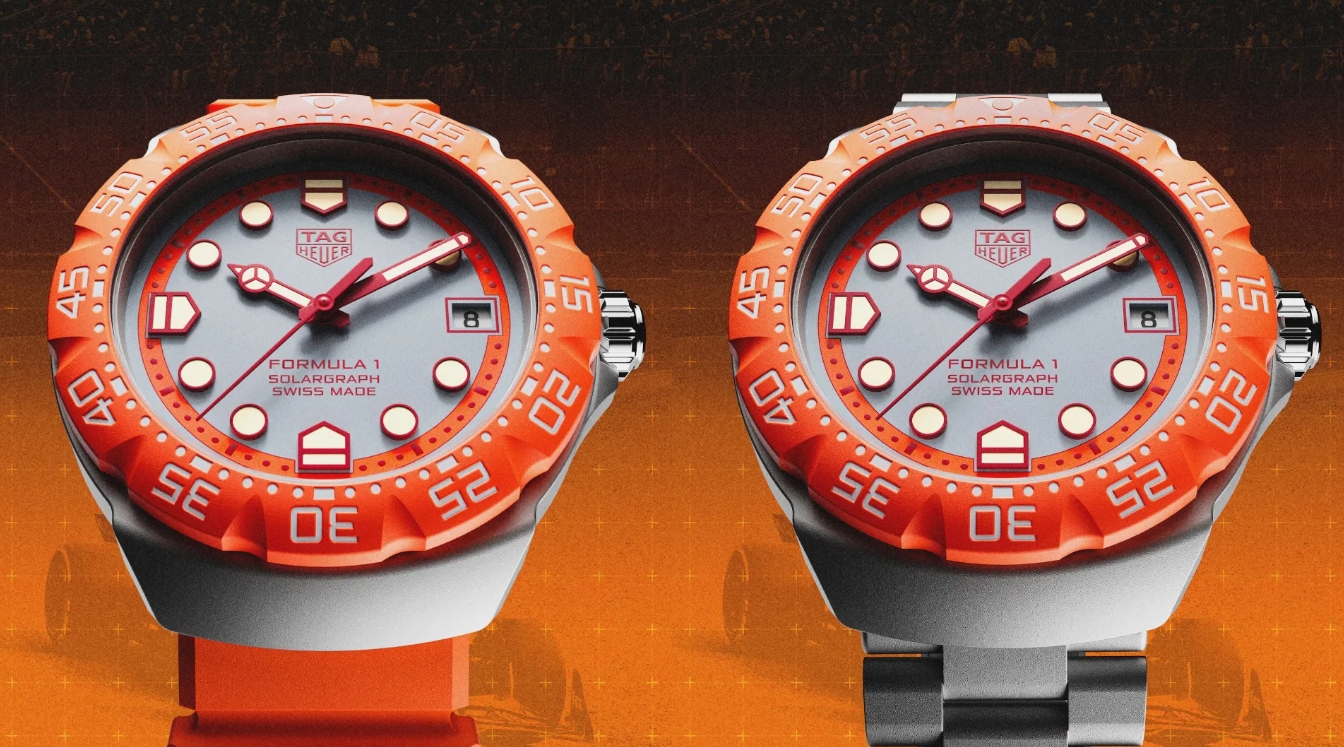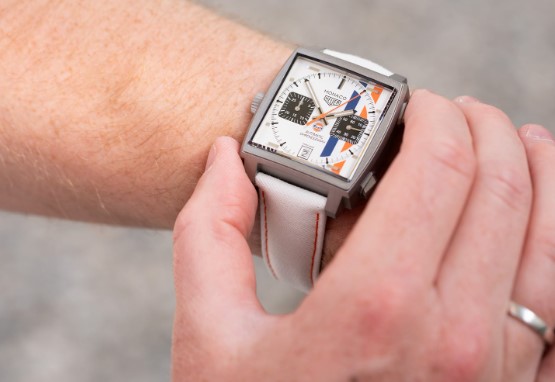
There could hardly have been a more obvious colour for a watch connected to Zandvoort. Orange has filled the grandstands at the Dutch Grand Prix for years, and TAG Heuer leaned fully into that identity with its latest Formula 1 Solargraph limited edition.
The timing gives the watch more meaning than a routine Formula 1 collaboration. The Dutch Grand Prix held at Circuit Zandvoort from 21 to 23 August 2026 was the final edition on the Formula 1 calendar, bringing the modern run of Max Verstappen’s home race to an end. TAG Heuer marked the occasion with two closely related Formula 1 Solargraph references built around a compact 38mm steel case, a grey dial and a very deliberate use of orange.
For readers looking at a replica TAG Heuer Formula 1 Solargraph Zandvoort watch, that distinctive design is useful. This is not a model where accuracy comes down to a small logo or an obscure movement engraving. The colour, proportions, bezel, dial and strap are all visible enough that differences can be spotted fairly quickly.
Rather than simply describing a watch as “AAA” or “1:1”, it makes more sense to start with what TAG Heuer actually produced and then look at the details a replica needs to reproduce convincingly.
Why the Zandvoort Edition Looks Different
The Formula 1 collection has always had a more playful relationship with colour than most of TAG Heuer’s catalogue. That makes the Zandvoort edition feel quite natural rather than like a standard watch with a new strap attached.
Its sandblasted stainless steel case keeps the basic watch relatively restrained, while the orange elements do most of the visual work. The grey opaline dial is surrounded by an orange and red flange, while red lacquer appears on the hands and applied hour markers.
The contrast is unusual. Orange and red are close enough to work together, but different enough that the dial does not turn into one large block of colour. The grey centre gives the eyes somewhere to rest.
That balance is one of the first things worth examining on a 38mm TAG Heuer Formula 1 Solargraph replica. If the grey is too dark, the orange too fluorescent or the red accents too dominant, the entire watch can look noticeably different even when its individual components are positioned correctly.

The 38mm Case Is an Important Reference Point
One detail that deserves clarification is the size. The genuine Zandvoort Formula 1 Solargraph has a 38mm case. That figure refers to the case diameter rather than the diameter of the dial.
The original case is approximately 9.9mm thick with an 18.5mm distance at the strap attachment. Those measurements help explain why the modern Solargraph feels compact despite its bright styling.
For a replica, case proportions are more important than simply matching the stated 38mm diameter. A watch can technically measure 38mm across while still looking wrong because the bezel is too wide, the mid case is too thick or the lugs extend differently.
Side profile photographs are therefore particularly useful. A front view can hide extra thickness, while a three quarter view usually reveals whether the bezel, crystal and steel case have been given the right proportions.
The Orange TH Polylight Bezel Is Hard to Hide
The bezel is probably the most recognisable part of this Zandvoort edition. TAG Heuer uses an orange TH Polylight bezel that can turn in both directions. It surrounds the grey dial and gives the watch much of its 1980s Formula 1 character.
A convincing replica needs to get more than the colour approximately right. Look at the shape of the bezel, the depth of the numerals and markers, the surface texture and the transition between the bezel and the steel case.
Orange is also surprisingly difficult to reproduce consistently in photographs. Lighting can make one example appear redder or brighter than another, so it is better to compare several images taken under neutral light rather than judge a watch from one heavily edited product photograph.
The Grey Dial Keeps the Watch From Becoming Too Loud
The centre of the genuine dial is grey and opaline rather than glossy black or metallic silver. Applied indexes and hands use red accents, while an orange and red flange creates the connection with the bezel.
The date sits at 3 o’clock. It may sound like a minor element, but date windows are often useful when comparing replicas because differences in movement construction can affect the position, depth and font of the date display.
When looking closely at a high quality Formula 1 Solargraph Zandvoort replica, it is worth checking the following:
- the position and size of the date window at 3 o’clock;
- the shade and texture of the grey dial;
- the spacing of the applied indexes;
- the length of the hour and minute hands;
- the thickness of the red lacquered details;
- the shape and placement of the TAG Heuer shield;
- the Formula 1 and Solargraph printing near 6 o’clock;
- the alignment between the dial flange and bezel markings.
None of these points is dramatic on its own. Together, however, they determine whether the dial feels convincing.

Super LumiNova Is Part of the Design Too
TAG Heuer uses an eggshell coloured Super LumiNova treatment on the genuine model. During the day it adds a slightly warmer tone to the indexes and hands, while the luminous material appears green in darkness.
This is another area where photographs taken only in bright studio lighting tell part of the story. If lume accuracy matters, it is useful to see both daylight photographs and images taken after the watch has been exposed to light.
Replica lume does not need to be judged solely by brightness. Colour, application consistency and the shape of the filled areas are just as important visually.
What the TH50 00 Solargraph Movement Actually Does
The genuine watch is powered by TAG Heuer’s Calibre TH50 00 Solargraph. It is a solar powered quartz movement that converts both natural and artificial light into stored energy.
A full charge can provide up to roughly ten months of autonomy, making the concept particularly suitable for a watch designed around simple daily wear. TAG Heuer also states that the rechargeable accumulator is designed for a lifespan of up to around 15 years.
This creates an important distinction when discussing replicas.
A replica may use a light powered quartz movement, an ordinary quartz movement or another construction entirely. A seller calling a movement “TH50 00” does not by itself establish that the internal mechanism is mechanically identical to TAG Heuer’s genuine Solargraph calibre.
For that reason, a replica TAG Heuer Solargraph movement comparison should separate three different questions:
- Does the watch actually charge from light?
- How long does it continue running without further exposure?
- Does the external behaviour of the seconds hand and date function match the genuine watch?
Those are much more useful questions than relying on a movement name printed in a listing.
Rubber Strap or Steel Bracelet
TAG Heuer produced two versions of the Zandvoort edition.
Reference WBY111H.FT8128 comes with a perforated orange rubber strap. This is the louder version and probably the one most people will immediately associate with Zandvoort because the orange continues from the bezel onto the wrist.
The second reference, WBY111L.BA0042, uses a sandblasted three row stainless steel bracelet. The watch head remains essentially the same, but replacing the orange strap with steel changes its character considerably.
The rubber version was limited to 1,500 pieces, while the steel bracelet version was limited to 1,000 pieces. The bracelet reference was also offered as an online exclusive.
If comparing replica versions, make sure the watch is being judged against the correct genuine reference. Details that are accurate for the rubber strap model should not automatically be assumed to belong to the bracelet edition.
Original Retail Prices Need to Be Kept Separate From Replica Pricing
The original TAG Heuer references launched at US$2,150 for the orange rubber strap version and US$2,250 for the steel bracelet version.
Those are prices for the genuine TAG Heuer limited editions, not prices that should be presented as though they apply to replicas.
This distinction matters in any comparison article. The original watch provides the design and technical benchmark, while a replica should be evaluated separately according to its own construction, movement and finishing.
How Closely Should a Replica Follow the Original?
This particular Formula 1 model gives buyers several straightforward areas to compare.
| Detail | Genuine Zandvoort Reference | What to Check on a Replica |
|---|---|---|
| Case | 38mm sandblasted stainless steel | Diameter, thickness and surface texture |
| Thickness | Approximately 9.9mm | Side profile and crystal height |
| Bezel | Orange bidirectional TH Polylight | Colour, markings, texture and rotation |
| Dial | Grey opaline with orange and red details | Colour balance, printing and index alignment |
| Date | 3 o’clock | Position, font and window depth |
| Movement | TH50 00 Solargraph quartz | Verify whether light charging actually works |
| Water resistance | 100 metres on the genuine watch | Do not assume the same rating without a pressure test |
| Strap option | Orange perforated rubber | Colour, perforation pattern and buckle shape |
| Bracelet option | Sandblasted three row steel bracelet | Link proportions, clasp and finishing |
A Formula 1 Watch That Makes More Sense With Context
Without the Zandvoort connection, this would simply be another brightly coloured Formula 1 Solargraph. The farewell to the Dutch Grand Prix gives the orange treatment a reason to exist.
Zandvoort’s modern Formula 1 era became closely associated with Dutch fans, Max Verstappen and grandstands filled with orange. By releasing the watch around the final race weekend, TAG Heuer tied a relatively accessible part of its collection to a specific moment in recent motorsport history.
That story also makes the model more interesting for readers comparing TAG Heuer Formula 1 replica watches, because it offers much more than a generic colour variation. There are two references, clearly defined production numbers and enough distinctive visual details to make meaningful comparisons possible.

What I Would Check Before Calling One a Good Replica
I would start with the case rather than the logo. The genuine watch is compact at 38mm and relatively slim, so an overly thick case would immediately change its character.
Next would be the orange bezel. It occupies too much visual space for the colour or markings to be noticeably wrong.
After that, I would look closely at the dial. Grey, orange and red need to sit together without one colour overwhelming the others. Date position, printing and hand proportions are all worth checking using clear reference photographs.
Finally, I would treat any Solargraph movement claim separately from the exterior. If a watch is advertised as solar powered, that function should be demonstrated rather than assumed from the words on the dial.
Readers who want to explore other Carrera, Monaco, Aquaracer and Formula 1 comparisons can also browse the broader replica TAG Heuer watch articles on TGWatch.
Final Thoughts
The Formula 1 Solargraph Zandvoort edition is one of those watches whose story can be understood almost immediately. Orange represents the crowd, the Formula 1 case ties it to TAG Heuer’s motorsport history, and its 2026 release marks the final Dutch Grand Prix at Zandvoort.
For replica comparisons, that simplicity is useful. There is little reason to rely on vague labels such as “perfect” or “AAA” when the watch offers so many specific details that can actually be examined.
A good comparison should begin with the 38mm case, 9.9mm profile, orange TH Polylight bezel, grey opaline dial, 3 o’clock date and the two distinct strap configurations. The movement deserves separate scrutiny, particularly if a replica claims to reproduce Solargraph charging.
Get those details right and the watch begins to capture what makes the Zandvoort edition recognisable. Get several of them wrong and no amount of marketing terminology will make the comparison convincing.